

Traditional equipment may experience vacuum fluctuations during long-term operation, causing loose packaging adsorption or unstable CNC panel holding, thus affecting the yield rate.
When a standard rotary vane pump stops, oil may easily seep back into the pipeline, contaminating the vacuum chamber and workpieces, and increasing cleaning costs.
Equipping each workstation with a single pump takes up more space and elongates daily inspection and maintenance routes, complicating spare parts management.
Some older models generate high noise and obvious vibration, which may interfere with nearby precision instruments when integrated into automated production lines.
Utilizing a rotary vane structure, it provides relatively fast pumping response in the medium vacuum range, suitable for processes requiring periodic vacuum establishment like packaging and blister forming.
The valve automatically cuts off the oil circuit during shutdown, helping to reduce the risk of oil backflow and keeping the pipeline and pump chamber clean.
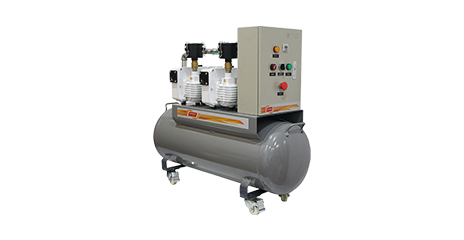
Can be embedded as a standalone pump unit or integrated with buffer tanks and PLC control cabinets to supply multiple points centrally, reducing distributed pumps.
Equipped with an industrial-grade motor and optimized heat dissipation air duct, it supports long-term continuous operation under conditions of good ventilation and matching working loads.
Compact body design with standard interfaces makes it convenient to connect to existing automated lines or embed into complete equipment, with relatively low daily maintenance.
Provides original accessories like intake filters and buffer tanks. Selection calculations are based on pumping speed and vacuum degree, with troubleshooting services available.
| Product Model | Motor Power | Ultimate Vacuum | Rated Voltage | Rated Flow | Rated Current | Industry Application |
|---|---|---|---|---|---|---|
LNVS 0040F H101 |
Vacuum Packaging |
The rotary vane pump mainly consists of a stator, rotor, and vanes. The rotor is eccentrically installed in the stator cavity, and the vanes slide against the inner wall under centrifugal force.
As the rotor turns, the intake chamber expands to draw in gas, while the exhaust chamber shrinks to compress and discharge it. Vacuum pump oil is injected into the chamber for sealing, lubrication, and cooling.
The system features an anti-oil-return structure that cuts off the oil circuit during shutdown, helping prevent oil from being sucked back into the vacuum pipeline and ensuring clean gas supply.
Compiled technical reference materials related to vacuum pumps for selection, equipment commissioning, and troubleshooting.
Vacuum pump units combine multiple vacuum pump types with intelligent control and integrated design to deliver stable, efficient vacuum for large-scale industri...
Vacuum pump oil is the dedicated working fluid for oil-sealed mechanical vacuum pumps, not ordinary engine, hydraulic or gear oil. Learn what it does and how to...
Extremely low vapour pressure sets vacuum pump oil apart from ordinary lubricants, while sealing, lubrication and cooling are its three core functions. Leynow e...
With rack power demand breaking records in AI training and supercomputing, 200kW-per-rack immersion liquid cooling relies on Leynow vacuum units for vacuum dega...
Cooling high-density racks is the core bottleneck for AI inference data centres. A hybrid cold plate and immersion design with Leynow vacuum units delivers ultr...
As AI models and HPC simulation expand rapidly, existing data centres face cooling bottlenecks. A 30kW-per-rack cold plate negative pressure solution solves the...

Vacuum packaging and blister forming, providing stable vacuum adsorption.

Holding panels firmly on engraving machine tables without displacement.

Material grasping on automated lines and vacuum supply for suction cups.

Vacuum source supply for drying ovens and defoaming machines.

Paper adsorption and conveying, vacuum holding for post-press processing.

Embedded as a built-in vacuum unit inside complete machines.

Provides continuous vacuum to ensure panels remain firmly in place.

Matches packaging cycles for rapid adsorption of film and materials.

Multi-suction cup coordination with fast vacuum response.

Provides a stable vacuum environment for drying chambers.

Provides stable paper adsorption force under high-speed operation.

Multiple units in parallel to supply vacuum centrally to multiple stations.
Usage Limitations: Suitable for extraction scenarios without large amounts of corrosive media and with controllable dust loads. If gas contains dust or water vapor, install front-end filters. Do not run with inlet/outlet blocked.
Selection Advice: Please provide target vacuum degree, single pumping volume and cycle, number of simultaneous stations, and media characteristics. For complex or explosion-proof requirements, consider Leynow customized solutions.
It needs to be calculated based on your chamber volume, target vacuum requirements, and single pumping time. Provide us with the parameters and we can assist in matching the model.
Leynow oil-lubricated systems typically feature a built-in anti-oil-return design to help reduce oil backflow risks during shutdown. Please refer to the specific model configuration.
Yes. It can be used standalone or integrated with buffer tanks and pipelines to supply negative pressure centrally to multiple workstations.
Regularly check the status and level of the vacuum pump oil, and clean or replace the intake filter based on the operating environment to ensure stable operation.
The equipment runs smoothly with an industrial motor. It supports integration inside equipment cabinets, provided that heat dissipation and noise reduction spaces are reserved.
Yes. We supply accessories like buffer tanks and filters, and provide technical consulting, troubleshooting guidance, and factory repair services.
Please fill in your requirements carefully, and we will contact you within 24 hours.

