

Open feeding or mechanical conveying easily generates dust at transfer points, polluting the workspace, increasing cleaning burdens, and affecting staff health.
Distributed vacuum pumps lead to long inspection routes, numerous devices, complex spare parts management, and large space occupation.
When workstations increase or decrease, or conveying distances change, the distributed pump architecture struggles to quickly adapt to pipeline and vacuum distribution adjustments.
Multiple single pumps operating simultaneously stack up energy consumption. Noise sources are scattered across the workshop, making centralized treatment difficult.
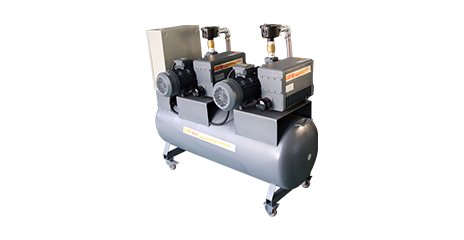
One vacuum station supplies vacuum to multiple material pick-up/feeding points in the workshop, reducing the number of distributed pumps and maintenance touchpoints.
Materials are conveyed in sealed pipes rather than open transfer, helping to reduce dust dispersion at transfer points and environmental dust levels.
Integrates automatic start/stop, vacuum monitoring, and multi-pump coordination logic. Operating status is centrally displayed for easy adjustment to production cycles.
Pipeline routing, branch numbers, and valve control methods are designed based on workshop layout and conveying distances, rather than fixed packages.
Significantly reduces the number of pump bodies and corresponding daily maintenance touchpoints, facilitating centralized management and reducing inspection workloads.
Releases production space originally occupied by distributed vacuum pumps, making the workshop layout cleaner and more efficient.
| Product Model | Motor Power | Ultimate Vacuum | Rated Voltage | Rated Flow | Rated Current | Industry Application |
|---|---|---|---|---|---|---|
| Vacuum Packaging |
The central vacuum station generates negative pressure and distributes it to each material pick-up station through a pre-designed pipeline network, forming a workshop-level vacuum supply network.
Under pressure difference, materials are drawn from pick-up points into sealed pipes and conveyed to target silos or equipment, completely sealed without dust dispersion.
Through centralized valve switching and PLC program interlocks, orderly, sealed, and automatic conveying to multiple stations is achieved, reducing manual intervention.
Compiled technical reference materials related to vacuum pumps for selection, equipment commissioning, and troubleshooting.

Sealed dust-free conveying of flour and medicinal powders, meeting hygiene standards.

Centralized feeding and transfer of various chemical raw materials and granules.

Centralized dehumidifying drying and pipeline conveying of plastic pellets.

Sealed conveying of battery cathode/anode materials and powder additives.

Centralized vacuum supply for multiple automated machines in the workshop.

Replacing scattered single pumps to build a centralized vacuum station.

Automatically drawing materials from storage tanks to reactors or mixers.

Connecting multiple dust extraction stations for centralized collection.

Distributing vacuum to machines via pipelines for centralized holding.

Distributing materials to the hoppers of multiple packaging machines.

Extracting production scraps and conveying them to recycling bins.

Reducing manual feeding dust and improving the workshop environment.
Usage Limitations: Evaluate if materials are prone to agglomeration or static electricity. Long-distance conveying requires calculation of pressure loss. Do not extract oversized foreign objects to avoid blocking pipes and pumps.
Selection Advice: Confirm material granularity, flowability, conveying distance and height difference, simultaneous station numbers, single conveying volume, and existing pipeline conditions. Anti-static pipes may be required.
It depends on material characteristics. Longer distances can be achieved through multi-stage vacuum or optimized pipeline design, requiring calculation of pipe resistance.
Reasonable pipeline flow rate design and pipe diameter matching significantly reduce the risk of blockage; this is factored into the system design.
Anti-static pipelines or grounding designs can be configured to ensure safety during powder conveying and prevent static buildup.
Yes, contact materials can be stainless steel or food-grade materials to meet relevant hygiene standards and ensure material safety.
Compared to multiple single pumps, the centralized control system operating with PLC logic helps reduce overall energy consumption.
The PLC system typically alarms and indicates the fault point. Contact our after-sales team for troubleshooting guidance and maintenance.
Please fill in your requirements carefully, and we will contact you within 24 hours.
